Powering the Future of Commercial Fleet Operations: A Complete Guide to EV Fleet Charging
Share Article

The Shift Toward Electric Fleet Operations
Commercial fleets are changing fast. Delivery companies, logistics operators, and service businesses are moving away from gasoline and diesel vehicles at an accelerating pace, driven by rising fuel costs, tightening emissions regulations, and pressure from customers and investors to demonstrate sustainability progress.
As researchers at the National Renewable Energy Laboratory put it, “Plug-in electric vehicles are reshaping the transportation energy landscape” (Muratori et al., OSTI/DOE, 2025).
“Plug-in electric vehicles are reshaping the transportation energy landscape.”
— National Renewable Energy Laboratory
At the center of every successful fleet electrification strategy is one critical element: EV fleet charging. Without a reliable, well-planned charging system, even the best electric vehicles can’t perform to their potential.
Whether you’re managing a handful of work vans or hundreds of delivery trucks, the right EV fleet charging infrastructure is what keeps your vehicles moving, your drivers productive, and your operating costs under control.

This guide walks through everything commercial operators need to know, from the basics of how EV chargers work to the specific steps involved in planning, financing, and scaling a fleet charging system.
EV adoption by the numbers:
- Electric vehicle sales in the U.S. grew from approximately 1.3 million registered EVs in 2021 to over 2 million in 2022, with cumulative U.S. plug-in EV sales reaching approximately 6.3 million through end of 2024 (ICCT / DOE AFDC)
- Globally, EVs surpassed 20% of all new car sales in 2024 for the first time, with over 17 million electric cars sold worldwide (IEA Global EV Outlook 2025)
- In the U.S., battery-electric vehicles accounted for 7.4% of all new light vehicle registrations in 2024, with EVs and plug-in hybrids combined reaching approximately 9% (S&P Global Mobility / Edmunds)
- By 2030, NREL projects 30 to 42 million EVs could be on U.S. roads, creating enormous demand for the charging infrastructure to support them
Basics of EV Charging
Before diving into fleet-specific considerations, it helps to understand how EV charging works at a foundational level.
EV charging equipment supplies electrical power to a vehicle’s onboard battery. Chargers are classified into three levels based on how quickly they can deliver that power. For a comprehensive breakdown of charger types and fleet-specific guidance, the U.S. Department of Energy’s Electric Vehicles for Fleets resource is an excellent reference.

Level 1 uses a standard 120-volt outlet and is the slowest option. It’s generally suited to light-duty vehicles that aren’t driven far each day and have plenty of time to recharge overnight. For most commercial fleet applications, Level 1 alone isn’t sufficient.
Level 2 operates on 240-volt power and charges significantly faster, typically delivering 10 to 30 miles of range per hour depending on the charger and vehicle. Level 2 is the most common choice for depot and workplace charging, offering a practical balance between cost, speed, and infrastructure requirements.
DC Fast Charging (also called Level 3) delivers high-voltage direct current directly to the battery, enabling rapid charging in 30 to 60 minutes for many vehicles. DC fast charging is best suited for fleets with tight duty cycles, mid-route top-ups, or vehicles that can’t sit idle overnight.

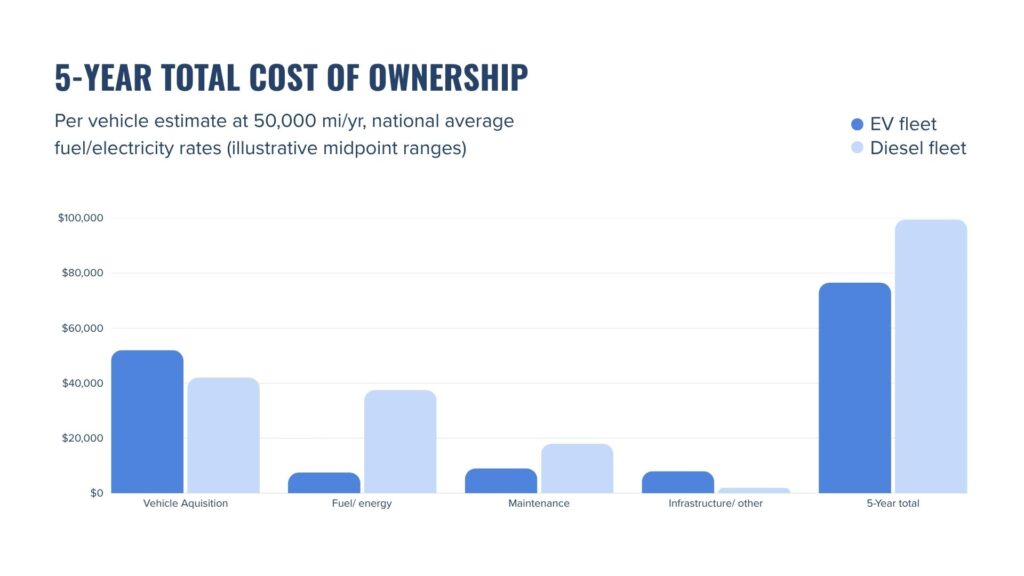
From a financial standpoint, fleet operators should evaluate charger hardware costs, electrical installation and utility upgrade costs, ongoing energy costs, and expected savings from reduced fuel and maintenance. Most fleets find that the total cost of ownership of an electric vehicle, once charging infrastructure is in place, is lower than a comparable internal combustion vehicle, particularly when time-of-use electricity rates and available incentives are factored in.
Understanding EV Fleet Charging
EV fleet charging differs from public or personal charging in both scale and complexity. A single commuter might plug in one car at home each night. A commercial fleet operator may need to charge 20, 50, or 200 vehicles at a single depot on a schedule that aligns with shift patterns, route demands, and energy costs.
That scale requires centralized infrastructure. Centralized EV fleet charging allows operators to manage all charging activity from a single platform, schedule sessions around off-peak energy rates, monitor vehicle state-of-charge in real time, and ensure every vehicle is ready for its next deployment.

Choosing between Level 2 and DC fast charging, or a combination of both, depends on your vehicles’ duty cycles. Fleets with predictable overnight dwell times, such as delivery vans and utility trucks, are well-served by Level 2 depot charging. Fleets with tight turnarounds or vehicles operating around the clock may require DC fast chargers to minimize downtime.
A carefully designed EV fleet charging strategy is one of the most important decisions in any fleet electrification project.
Fleet EV Charging
Ready to electrify your fleet?
FSG designs, installs, and maintains EV charging infrastructure built for commercial fleets — from site assessment to long-term service.
Key Components of an EV Fleet Charging System
A complete EV fleet charging system is more than just the chargers themselves. The key components include:
Charging Hardware refers to the physical charging stations, including the connectors, cables, and power electronics that interface with each vehicle.
Energy Management and Load Balancing Software: Smart charge management coordinates when each vehicle charges, distributes power across the site to avoid exceeding electrical capacity, and shifts charging load to lower-cost periods. This is where significant cost savings are realized.
Utility Coordination is often required at scale, as fleet charging frequently necessitates upgraded electrical service. Early coordination with the local utility helps identify available rate structures, rebates, and timeline requirements for service upgrades.
Telematics Integration connects charging management software to your fleet telematics platform, giving operators a complete view of vehicle location, state-of-charge, and charging history. This data is critical for optimizing schedules and demonstrating ROI.
Together, these components form an integrated electric vehicle fleet charging infrastructure that needs to be planned holistically rather than assembled piecemeal.

Benefits of Implementing EV Fleet Charging Infrastructure
For commercial operators weighing the transition to electric, the benefits of proper EV fleet charging infrastructure are concrete and measurable.
What the data shows for commercial fleets:
- 64% of fleet professionals already operate EVs in their fleets, and 87% plan to add EVs within the next five years (Cox Automotive 2024 Path to EV Adoption Study)
- The share of fleets with 20–50% EV penetration is expected to jump from 7% in 2024 to 36% in 2025 (Qmerit 2025 EV Fleet Conversion Survey)
- EVs cost approximately 60–80% less per mile to fuel than diesel or gasoline equivalents (U.S. DOE)
- EV maintenance costs are roughly 50% lower over the life of the vehicle compared to internal combustion engine vehicles (Consumer Reports)
- The U.S. had approximately 204,000 public and publicly accessible workplace charging ports deployed as of end of 2024, up 35% from mid-2023, yet infrastructure investment must grow significantly to keep pace with fleet demand (ICCT, 2025)
Lower Fuel and Maintenance Costs: Electric drivetrains have fewer moving parts than combustion engines. There’s no oil to change, fewer brake replacements thanks to regenerative braking, and fewer components that wear out. Combined with lower per-mile energy costs compared to gasoline or diesel, the savings add up quickly.
Reduced Emissions and Sustainability Compliance: Many jurisdictions are tightening fleet emissions requirements. EV fleet charging infrastructure enables compliance while also supporting voluntary ESG commitments that increasingly matter to investors, customers, and partners.
Predictable Operating Costs: With smart charging and time-of-use rate management, electricity costs are far more stable than fluctuating diesel prices. Budget planning becomes more accurate and reliable. FSG’s Energy as a Service model can also help convert large upfront infrastructure costs into manageable operating expenses.
Improved Operational Efficiency: Depot charging eliminates fuel stops. Vehicles are ready at the start of each shift, charged to the level needed for that day’s routes. Integrated telematics means dispatch has real-time visibility into vehicle availability.
Long-Term ROI and Sustainability Impact
The long-term return on fleet electrification is well-documented. Fuel savings alone often account for $2,000 to $5,000 per vehicle per year, depending on vehicle type and utilization. Maintenance savings compound on top of that, and carbon reduction is measurable and can be reported against corporate sustainability goals.
Realizing that ROI requires matching your charging system’s capacity to your fleet’s actual needs, without undersizing infrastructure in ways that limit growth or oversizing it in ways that inflate upfront costs unnecessarily. That alignment starts with a thorough site assessment and load study, which experienced partners like FSG conduct as part of the planning process.
Key Considerations When Planning EV Fleet Charging
Planning is where successful fleet electrification projects are won or lost. The decisions made early, about charger types, quantities, electrical capacity, and utility relationships, shape cost and performance for years to come.

Site Assessment and Electrical Capacity: Every deployment starts with understanding what your site can support today and what upgrades may be required. A load study identifies peak demand requirements and confirms whether existing electrical infrastructure can handle fleet charging without costly emergency upgrades later.
Charging Speed and Quantity: Match charger type to duty cycle. Level 2 chargers are the right choice for most overnight depot applications, while DC fast chargers are appropriate where rapid turnaround is essential. Quantity is a function of fleet size, dwell times, and acceptable downtime if a charger is out of service.
Utility Partnerships and Incentives: Engaging your utility early is one of the highest-leverage steps in fleet charging planning. Many utilities offer demand response programs, special commercial EV rates, and rebates for charging equipment and installation. FSG’s utility incentives team can help identify and apply for all available programs in your market.
Permitting and Compliance: Local permitting requirements vary significantly. Experienced installation partners know what’s required in your jurisdiction and can manage the permitting process to avoid delays.
Managing Energy Loads and Peak Demand
One of the most significant ongoing costs in fleet EV charging is demand charges, the fees utilities assess based on peak power draw during billing periods. Unmanaged charging, where all vehicles plug in simultaneously at shift end, can create demand spikes that inflate energy bills substantially.
Managed EV charging addresses this directly. By staggering charging sessions, prioritizing vehicles based on next-day route requirements, and shifting charging to off-peak windows, smart systems eliminate unnecessary demand charges. Adding on-site energy storage extends this capability further, storing energy during low-cost periods and dispatching it during peaks. Pairing EV fleet charging with commercial solar can further reduce grid dependence and improve site resilience during outages.

Scalable Solutions for Growing Fleets
The most cost-effective fleet charging systems are designed with future growth in mind. Selecting modular hardware, reserving physical space for additional chargers, and sizing electrical infrastructure to accommodate expansion avoids expensive retrofits as your fleet grows. The goal is a system that’s right for today and ready for tomorrow, without paying for tomorrow’s capacity upfront.
How FSG Supports EV Fleet Charging Projects
FSG is a nationwide electrical and technology services contractor with deep expertise in EV fleet charging infrastructure. From initial site assessment through long-term maintenance, FSG provides turnkey services that take the complexity out of fleet electrification.
What FSG offers:
Site assessments and load studies that establish electrical requirements and identify utility upgrade needs before any equipment is purchased.
System design and engineering that matches charging hardware, software, and electrical infrastructure to your fleet’s specific duty cycles and growth plans.
Permitting and utility coordination managed by FSG’s experienced project teams, reducing delays and surprises.
Installation and commissioning across single-site and multi-site deployments, handled by FSG’s certified electricians and field teams.
Ongoing maintenance and service plans that keep chargers operational and minimize fleet downtime.

FSG’s experience spans delivery fleets, municipal vehicles, transit operations, and field service fleets, giving FSG’s teams practical insight into the operational realities each fleet type faces.
For more on FSG’s capabilities, visit our commercial EV charging solutions page, or read our guide to commercial EV charging for property managers and business owners to see how other operators are approaching this transition.
The Future of Commercial EV Fleet Charging
The technology supporting EV fleet charging continues to advance rapidly. Several developments are worth tracking as you plan for the long term.
Wireless (Inductive) Charging: Pads embedded in the floor of parking bays can charge vehicles automatically when parked, without requiring a physical plug. While still emerging for heavy commercial use, wireless charging is gaining traction for transit and light-duty applications.
Vehicle-to-Grid (V2G) Integration: V2G technology allows electric vehicles to discharge energy back to the grid during peak demand periods, effectively turning your fleet into a distributed energy asset. Fleet operators can earn revenue from grid services while still ensuring vehicles are charged for next-day operations. FSG’s energy solutions team can help you assess whether V2G or demand response programs make sense for your operation.
AI-Driven Energy Management: Artificial intelligence is improving the precision of charging optimization by forecasting route energy requirements, predicting grid pricing, and dynamically adjusting charging schedules in real time. As these systems mature, the gap between manually managed and AI-optimized fleets will widen considerably.
Partnering with an experienced provider like FSG ensures your charging infrastructure is designed to accommodate these advances as they become commercially viable, rather than being locked into today’s technology with no path to upgrade.
Driving Forward with Reliable Fleet Charging Solutions
EV fleet charging is no longer a niche consideration for early adopters. It is a strategic investment that directly affects operating costs, sustainability performance, and competitive positioning for commercial fleets of every size.
A well-designed, properly managed EV fleet charging system lowers fuel and maintenance costs, improves vehicle availability, and positions your operation to meet the regulatory and customer demands that will only intensify in the years ahead.
FSG is ready to help you get there, with the technical expertise, national reach, and turnkey service capabilities to take your fleet from planning to full operation. Contact FSG to schedule a site assessment and take the first step toward a more efficient, sustainable fleet.
Fleet EV Charging
Ready to electrify your fleet?
FSG designs, installs, and maintains EV charging infrastructure built for commercial fleets — from site assessment to long-term service.