Fluorescent Lighting Bans: What Commercial Property Owners Need to Know
Share Article

Fluorescent lighting is on its way out. Across the United States, a growing number of states have enacted laws banning the sale and distribution of compact fluorescent lamps (CFLs) and linear fluorescent tubes, with more legislation in the pipeline.
What started with a handful of early movers like Vermont and California has expanded into a nationwide trend. As of mid-2026, more than a dozen states plus Washington, D.C. have some form of fluorescent lighting restriction on the books.
The driving forces behind these bans are straightforward. Fluorescent lamps contain mercury, a toxic heavy metal that creates serious health and environmental risks when bulbs break or are improperly disposed of. At the same time, LED technology has matured to the point where it outperforms fluorescent lighting in virtually every measurable category, from energy efficiency and lifespan to light quality and maintenance costs.
For commercial property owners and facility managers, the impact goes beyond regulatory compliance. Even in states without active bans, manufacturers are shifting production entirely to LED, making fluorescent replacement lamps harder to find and more expensive to source.
The supply of fluorescent products is shrinking whether your state has passed legislation or not. Businesses that plan their transition now will avoid scrambling for inventory, take advantage of utility rebates while they still exist, and position themselves ahead of regulations that are clearly headed in one direction.
Why Are States Banning Fluorescent Lighting?
The push to phase out fluorescent lighting comes down to two core issues: the environmental and health hazards of mercury, and the availability of a clearly superior alternative in LED technology.
Fluorescent lamps rely on mercury vapor to produce light. While the amount of mercury in a single bulb is small, the cumulative impact is significant when you consider the billions of fluorescent lamps in use across commercial, industrial, and residential buildings in the United States.
When these bulbs break during use, handling, or disposal, mercury is released into the air and can travel hundreds of miles before settling into soil and water. Once deposited, mercury enters the food chain and poses serious risks to both human health and wildlife. The Environmental Protection Agency has linked mercury exposure to neurological damage, kidney problems, and developmental issues in children.
Beyond the disposal challenges, fluorescent lamps are also costly to manage from a hazardous waste standpoint. Businesses are required to handle spent fluorescent tubes as universal waste under federal regulations, which adds logistical complexity and expense to something as routine as changing a light bulb.

LED lighting eliminates these concerns entirely. LEDs contain no mercury or other hazardous materials, which simplifies both disposal and compliance. They also consume up to 75% less energy than their fluorescent counterparts and last significantly longer, with high-quality commercial LED fixtures routinely rated for 100,000 hours or more. That translates directly into lower utility bills, fewer lamp replacements, and reduced maintenance labor.
The light quality is better too. LEDs offer superior color rendering (CRI), consistent brightness over their lifespan, and dimming capabilities that fluorescent technology was never designed to deliver.
With a safer, more efficient, and more cost-effective option readily available, the regulatory shift away from fluorescent lighting is less a question of if and more a matter of how quickly each state acts.
Which States Are Banning Fluorescent Light Bulbs?
The fluorescent phase-out is not happening at the federal level alone. Individual states have been moving faster than federal regulators, passing their own legislation to ban the sale and distribution of CFLs and linear fluorescent tubes on accelerated timelines. As of mid-2026, 15 states and Washington D.C. have enacted some form of fluorescent lighting restriction, and more legislation is in the works.
These restrictions generally fall into two categories. The first is a broad ban, where a state has passed legislation prohibiting the sale of all or most fluorescent lamp types, including screw-base CFLs, pin-base CFLs, and linear fluorescent tubes like T8s and T12s. States in this category include California, Colorado, Hawaii, Illinois, Maine, Minnesota, Oregon, Rhode Island, Vermont, and Washington. Many of these bans are already in effect, with the last major deadline being Washington’s full ban set for January 1, 2029.
The second category is a high-CRI restriction, in which a state has banned only high-CRI fluorescent lamps, typically those with a CRI of 87 or higher. These lamps produce higher-quality light but are less energy-efficient and contain mercury just like standard fluorescents.
States with high-CRI-only restrictions currently include Maryland, Massachusetts, Nevada, New Jersey, New York, and Washington, D.C. Several of these states have proposed broader bans that have either stalled in committee or been vetoed, but the direction of the legislation is clear.
The chart below provides a full breakdown of each state’s ban status, the types of fluorescent lamps affected, and the effective dates for each restriction.
U.S. Fluorescent Lighting Bans by State
Effective dates for the prohibition of sale and distribution of compact fluorescent lamps (CFLs) and linear fluorescent tubes. Chart current as of July 2026.
| State | Ban Type | Legislation | Screw-Base CFL | Pin-Base CFL | Linear Fluorescent |
|---|---|---|---|---|---|
| States with Broad Fluorescent Bans | |||||
| California | Full Ban | AB 2208 | Jan 1, 2024 |
Jan 1, 2025 |
Jan 1, 2025 |
| Colorado | Full Ban | HB23-1161 | Jan 1, 2025 |
Jan 1, 2025 |
Jan 1, 2025 |
| Hawaii | Full Ban | HB 192 | Jan 1, 2025 |
Jan 1, 2026 |
Jan 1, 2026 High-CRI banned since 2021 |
| Illinois | Full Ban | HB 2363 | Jan 1, 2026 |
Jan 1, 2027 |
Jan 1, 2027 |
| Maine | Full Ban | LD 1814 | Jan 1, 2025 |
Jan 1, 2026 |
Jan 1, 2026 |
| Minnesota | Full Ban | HF 3911 | Jan 1, 2025 |
Jan 1, 2026 |
Jan 1, 2026 |
| Oregon | Full Ban | HB 2531 | Jan 1, 2024 |
Jan 1, 2025 |
Jan 1, 2025 High-CRI banned since 2023 |
| Rhode Island | Full Ban | HB 5550 | Jan 1, 2024 |
Jan 1, 2025 |
Jan 1, 2025 |
| Vermont | Full Ban | Act 120 | Feb 17, 2023 |
Not yet covered |
Jan 1, 2024 4-foot tubes only |
| Washington | Full Ban | HB 1185 | Jan 1, 2029 |
Jan 1, 2029 |
Jan 1, 2029 High-CRI already banned |
| States with High-CRI Restrictions Only | |||||
| Maryland | High-CRI | State efficiency std. | No ban |
No ban |
Oct 1, 2024 CRI ≥87 only |
| Massachusetts | High-CRI | State efficiency std. | No ban |
No ban |
Active CRI ≥87 only |
| Nevada | High-CRI | State efficiency std. | No ban |
No ban |
Active CRI ≥87 only; broader ban vetoed |
| New Jersey | High-CRI | State efficiency std. | No ban |
No ban |
Jan 18, 2023 CRI ≥87 only |
| New York | High-CRI | S4691(pending) | Pending (S4691) |
Pending (S4691) |
Jun 26, 2023 CRI ≥87; broader ban in Assembly |
| Washington D.C. | High-CRI | D.C. efficiency std. | No ban |
No ban |
Active CRI ≥87 only |
Sources: State legislature records including CA AB 2208, CO HB23-1161, HI HB 192 (Act 225), IL HB 2363, ME LD 1814, MN HF 3911, OR HB 2531, RI HB 5550, VT Act 120, WA HB 1185, and NY S4691. Dates reflect sales prohibition start dates. Most bans do not require removal of existing installed fixtures. Check your state’s specific legislation for exemptions and sell-through provisions.
It is worth noting that most of these bans apply to the sale and distribution of new fluorescent lamps, not to the use of lamps already installed in existing fixtures. Businesses are not required to rip out working fluorescent lighting on day one.
However, once a ban takes effect, replacement lamps will no longer be available through normal supply channels in that state, which means any fluorescent system still in operation is on borrowed time.
Common Exemptions Across State Bans
While each state’s legislation is written independently, the exemptions are remarkably consistent from one ban to the next. Most states recognize that certain specialized applications still depend on fluorescent technology and have carved out allowances accordingly.
The most common exemptions include fluorescent lamps used for image capture and projection, such as those found in printing, photography, and film production. Lamps designed for ultraviolet applications are also typically exempt, including those used in germicidal disinfection, water treatment, and specialty processes like coral growth in aquaculture. Medical, veterinary, and scientific research lamps that require specific spectral output generally fall outside the scope of these bans as well.
Some states also provide short-term sell-through windows that allow retailers to clear existing fluorescent inventory after a ban takes effect. Washington, for example, permits the sale of remaining stock until July 1, 2029, six months after its ban begins. These grace periods vary by state, so businesses should check their specific state legislation for details.
The key takeaway for most commercial property owners is that standard fluorescent lamps used in general lighting, the T8s, T12s, and CFLs found in offices, warehouses, retail spaces, and industrial facilities, are not exempt. If your building relies on general-purpose fluorescent lighting, the bans apply to you.
How Businesses Should Prepare for the Fluorescent Lighting Ban
Whether your state has already enacted a ban or is expected to follow suit in the coming years, the time to plan your transition is now. Waiting until fluorescent lamps are no longer available creates unnecessary risk, from compliance issues and supply shortages to higher costs when demand for LED retrofits spikes closer to enforcement deadlines. A proactive approach puts you in control of the timeline and the budget.
The first step is to evaluate your current lighting inventory. Walk your facilities and document the types and quantities of fluorescent lamps in use, including the fixture types they sit in. Knowing whether you are running T8s, T12s, pin-base CFLs, or screw-base CFLs will determine the scope of your retrofit and help a lighting specialist design the right replacement plan. This is also a good time to assess the condition of your existing fixtures and ballasts, since older infrastructure may warrant a full fixture replacement rather than a simple lamp swap.
From there, partner with a qualified lighting specialist who can design an LED retrofit plan tailored to your facilities. A good lighting partner will conduct a photometric analysis to ensure your replacement system delivers the right light levels for your space while maximizing energy efficiency.
This matters because a one-for-one lamp swap does not always produce the best result. LED technology offers superior optics and directional light output, which means a well-designed system can often deliver better light coverage with fewer fixtures and lower energy consumption.
Take advantage of utility rebates and incentive programs while they are still available. Many utility providers currently offer rebates for LED upgrades, but several have already announced plans to phase out these programs as fluorescent bans take effect. Businesses that act now can offset a significant portion of their retrofit costs through these programs. Once the rebates are gone, the full cost of the upgrade falls on the property owner.
Finally, make sure your facilities team understands the regulatory landscape. Anyone responsible for ordering replacement lamps or managing building maintenance should be aware of the ban timelines in your state so that future purchasing decisions are LED-compliant from the start.
Benefits of Switching to LED Lighting
The fluorescent lighting bans are accelerating a transition that already makes strong financial and operational sense on its own. Even without regulatory pressure, the case for LED lighting in commercial and industrial facilities is difficult to argue against.
The most immediate benefit is energy cost reduction. LED lighting consumes significantly less power than fluorescent systems to produce the same or better light output. For businesses operating large facilities with hundreds or thousands of fixtures running extended hours, the savings on monthly utility bills add up quickly. In many cases, the energy savings alone are enough to pay back the cost of an LED retrofit within two to three years.
Maintenance costs drop substantially as well. High-quality commercial LED fixtures are routinely rated for 50,000 to 100,000 hours of operation, compared to 7,000 to 15,000 hours for a typical fluorescent tube. That translates to far fewer lamp replacements, fewer service calls, and less disruption to daily operations. For facilities with high ceilings, hard-to-reach fixtures, or 24/7 operating schedules, the reduction in maintenance labor alone can be a significant line-item savings.
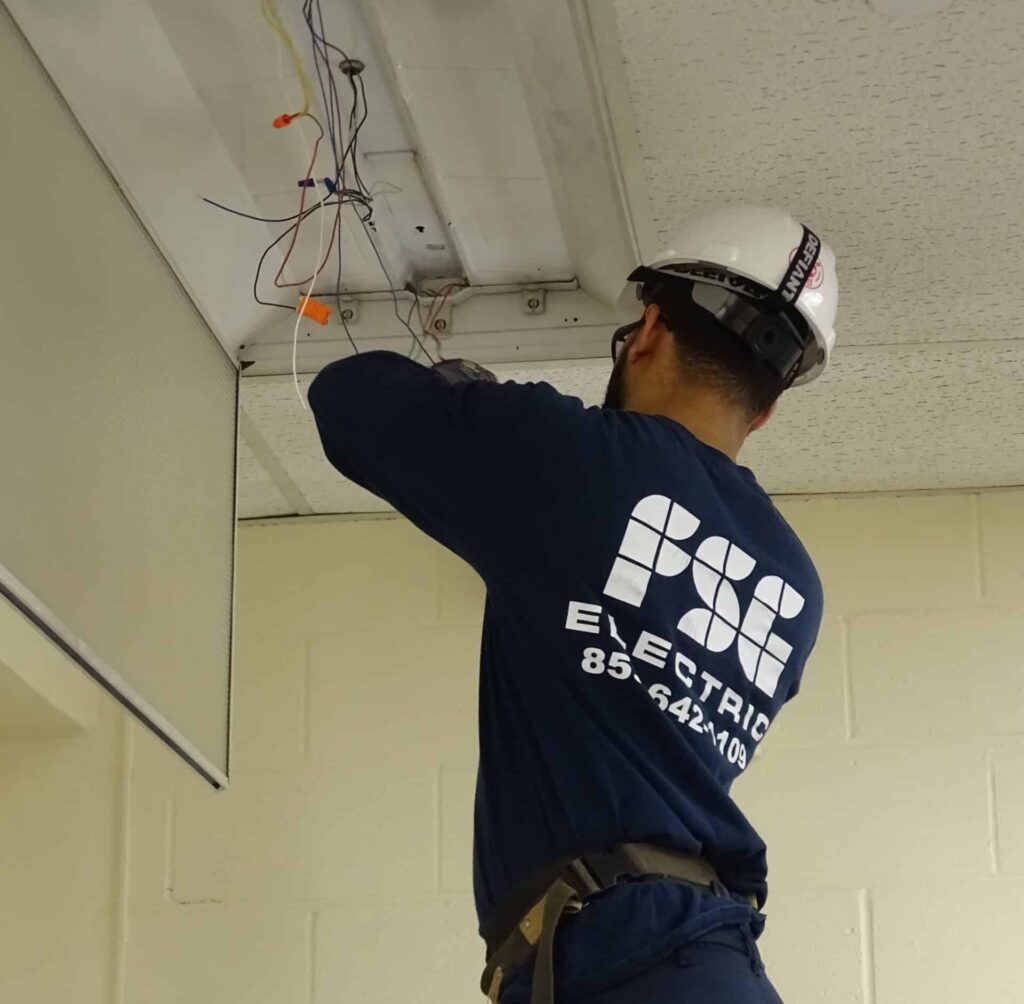
Light quality is another area where LEDs outperform fluorescents across the board. LEDs offer superior color rendering, consistent brightness over their full lifespan, and dimming capabilities that fluorescent technology cannot match. Fluorescent tubes degrade over time, losing a noticeable percentage of their initial brightness well before they burn out. LEDs maintain their output far more consistently, which means better visibility, fewer complaints, and a more comfortable environment for employees, tenants, and customers.
There is also the environmental benefit. LEDs contain no mercury or other hazardous materials, which eliminates the disposal and handling requirements that come with fluorescent lamps. Fewer watts consumed per fixture means lower carbon emissions tied to your building’s energy use. For businesses with sustainability commitments or ESG reporting requirements, an LED retrofit is one of the most straightforward and measurable steps you can take.
Act Now to Stay Compliant and Save on Lighting Costs
The fluorescent lighting phase-out is not a distant policy discussion. Bans are already in effect across multiple states, manufacturers are shifting production away from fluorescent products, and the supply of replacement lamps is shrinking by the month. Businesses that wait to act will face fewer options, higher costs, and tighter timelines.
FSG has been helping businesses navigate lighting transitions for more than 41 years. Whether you need a full facility audit, a phased LED retrofit plan, or guidance on utility rebates and incentive programs in your area, our team has the experience and national reach to keep your properties compliant and operating efficiently.
Contact FSG today to start planning your transition from fluorescent to LED. A proactive approach now means lower costs, better light, and one less compliance deadline to worry about.