What Is Energy As A Service (EaaS)? FSG Can Help You Understand It
Share Article

Many commercial and industrial facilities have some amount of energy waste that can be reduced. However, oftentimes businesses choose not to address the issue due to the capital expenses related to energy upgrades. The outdated lighting systems, inefficient operation of HVAC systems, untapped potential for solar panels on a roof, and increasing utility bills are familiar to any property manager.
U.S. Energy Information Administration data shows that in 2018, commercial buildings consumed 6.8 quadrillion BTU of energy, and the main users of this energy were space heating, ventilation, and lighting. While the issue of energy efficiency is rarely left unaddressed, the capital is always a problem.
Improving the existing energy infrastructure requires considerable investments, and convincing the leadership to authorize such projects is not always easy. Because of this, Energy as a Service (EaaS) was created specifically for the situation where there are too many obstacles to upgrading the existing energy systems.
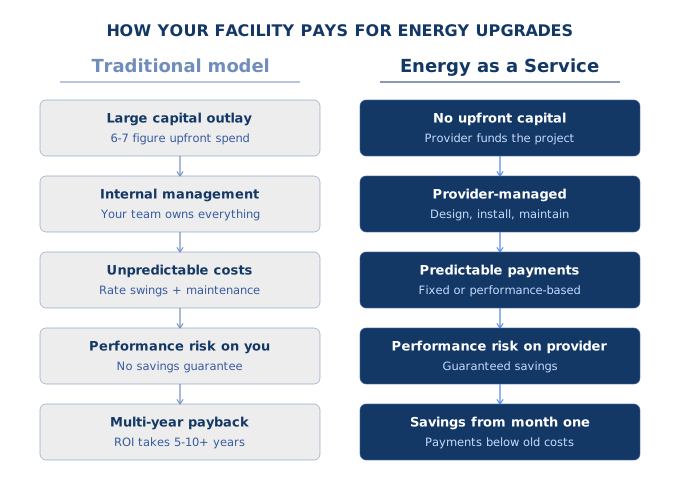
A project is funded and implemented by a provider in exchange for guaranteed performance metrics. The advantages of this model are the absence of upfront investment, internal engineering effort, and uncertainty regarding return on investment.
What is Energy as a Service?
Energy as a Service (EaaS) is a model in which a third-party provider implements energy upgrades in a building, and the facility owner pays for them according to the results instead of the cost of installed equipment. The risk is assumed by the provider, and if the project fails, it is not the responsibility of the client.
The scope of an EaaS agreement varies depending on the requirements of a particular facility. In some cases, it is limited to installing new lighting, and, in other cases, the provider implements multiple technologies. These can include solar generation, battery storage, backup power systems, electric vehicle charging stations, and building automation.
However, in any EaaS contract, the provider is responsible for achieving the required level of performance, and the customer pays for that performance.
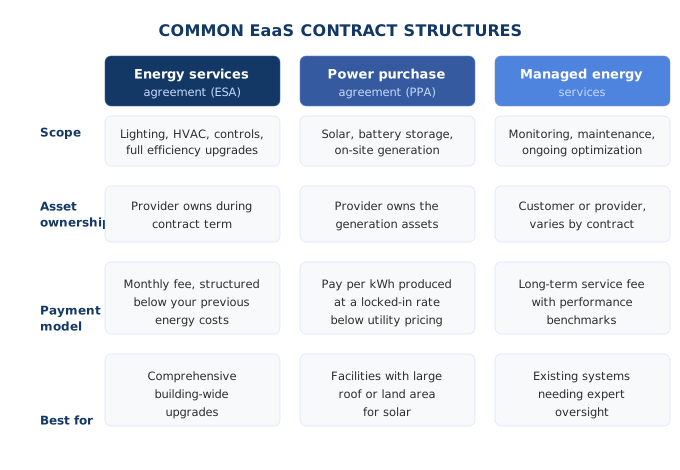
There are three basic types of agreements worth mentioning:
Energy Services Agreement (ESA): the provider finances and installs the upgrades, and the customer pays the lower fee compared to the energy cost before the project’s implementation.
Power Purchase Agreement (PPA): specific to generation projects when the customer buys the generated energy at the agreed price.
Managed energy services agreement: the ongoing monitoring and optimization of the system is provided according to the terms of the contract.
There is also a long history of performance-based energy contracting model in the U.S. Federal Sector, where the Energy Savings Performance Contracting (ESPC) of the U.S. Department of Energy helps to fund billions of dollars’ worth of facility upgrades without any upfront appropriation.
Most of the providers, including FSG, can customize the agreement structure to fit the project and the customer’s financial needs.
Why Facilities Move to Energy as a Service?
The first, and the most obvious reason, is financial. Energy upgrades require considerable investments in infrastructure, and many organizations cannot get approval for this expense or simply don’t want to finance it directly. With the Energy as a Service model, there is no need to finance the project, since it is handled by the provider, and the customer pays for the results. In the majority of cases, the building starts saving money right from the first month of the project.
This model provides the predictability of costs. Utility prices change, equipment needs maintenance, and these additional expenses can be hard to estimate. EaaS agreement fixes the cost at a specific level and makes budget forecasting and planning easy.
The EaaS agreement eliminates the need for monitoring and maintaining of the systems, as this process is handled by the provider according to the agreement. In the case of old electrical or lighting systems, this can significantly reduce the risk of failures and decrease the workload of the facility staff.
Sustainability goals also contribute to this trend. Many organizations have their carbon reduction objectives, and Energy as a Service is a convenient way to implement solar panels, battery storage, and other technologies without acquiring the necessary skills and conducting the project.
According to the EPA’s ENERGY STAR program, energy consumption of certified buildings is 35% less than in other facilities, and EaaS allows implementing these upgrades in a relatively short period of time.
Who Should Consider Energy as a Service?
EaaS can be applied to various commercial and industrial facilities, but certain facility types are more promising due to their energy consumption profile and improvement potential.
The first group is warehouse and distribution centers that use massive lighting systems running 18-24 hours a day, and using outdated metal halide or fluorescent lamps. As stated by ENERGY STAR, lighting consumes 17% of the energy used in U.S. commercial buildings, and LEDs use up to 90% less than traditional lighting. LED lighting retrofit with occupancy-based control system implemented in a distribution center of 200,000 sq. ft. reduces energy consumption by 60% or more. When combined with rooftop solar, it makes the situation even better.
Multiple-site retail and restaurant chains face a similar situation on a smaller scale. Every site may not be a big consumer of energy individually, but the cumulative effect is substantial, and organizing an upgrade on many sites is a project management nightmare. EaaS allows implementing standardized lighting, HVAC, and control system upgrades under a single agreement.
Healthcare facilities are also intensive energy consumers, as hospitals and some clinics operate 24/7, requiring precise temperature and humidity control and reliable backup power. Failure of the system in this case means not just inconvenience but health risks to patients. EaaS allows healthcare organizations to upgrade their systems, improve their energy efficiency and reliability, and keep up with regulations without diverting capital.
Manufacturing plants have some of the highest energy consumption among commercial facilities. They are characterized by process load, an air compression system, and large-scale lighting of production floors. EaaS allows manufacturing facilities to save money without any direct investment and increase their competitiveness.
Finally, municipal and government facilities have problems with aged systems due to deferred maintenance, but also have financial and procurement restrictions for capital projects. EaaS allows these facilities to modernize their systems according to their financial capabilities and procedures.
Energy as a Service by FSG
As mentioned above, most of the EaaS providers specialize in one area of work, like solar or lighting, and then subcontract other services. FSG differs from most of the providers as it already provides all services needed for an Energy as a Service project. Our services include lighting, electrical work, solar, battery storage, EV charging, backup power, smart building controls, and proactive maintenance services.
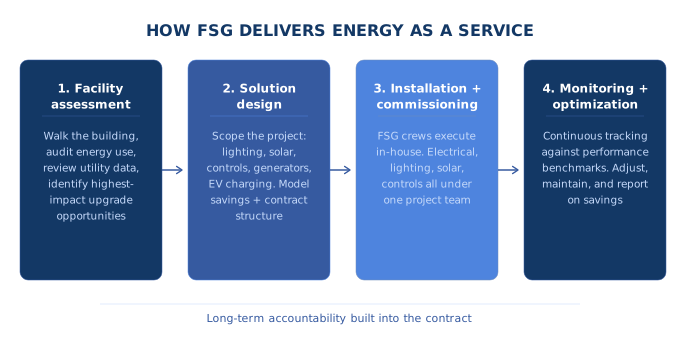
The engagement usually starts with a facility assessment that identifies the places where the energy loss occurs and where the greatest improvements can be achieved. After the initial research, FSG’s engineers develop the scope of work that can include LED retrofit with networked controls, solar panel array with battery storage, backup power generators, or their combination.
After the implementation of the upgrades, FSG doesn’t just disappear from the scene. Long-term monitoring and optimization services that ensure continuous tracking of the system performance and adjustment are a part of the agreement.
What to Look for in an EaaS Provider?
There are numerous EaaS providers on the market, and not all of them offer true energy as a service. Some are financing companies with a little energy expertise, and others are single trade contractors that can install a system but will subcontract the installation of other systems. Before implementing a long-term energy agreement, there are a few questions to address.
Find out what services the provider performs on their own. In the case when the company proposing an EaaS solution will subcontract services to other vendors, this is not an energy as a service solution. You are likely getting a financing agreement with high coordination risk. Providers that can implement the whole scope of work by themselves usually achieve better results.
Next, understand how performance is measured and what happens in case the target is not met. In order to make the agreement credible, the provider should include energy performance benchmarks, measurement and verification processes, and guarantees that, in case the savings are not reached, they will compensate the difference. There are numerous tools available for measurement, for example, ENERGY STAR’s Portfolio Manager tool that measures the energy performance of almost 25% of all commercial buildings in the United States.
You should check the provider’s experience working with your facility type. For example, a company that has retrofitted hundreds of warehouses approaches a distribution center differently than the provider with a primarily office buildings portfolio. This means that mechanical systems, lighting layouts, operating schedules, and utility rate structures will differ, and the provider that knows your facility type will be able to provide better results.
Lastly, you should clarify the post-installation services. Continuous monitoring, maintenance, and optimization are what make the EaaS a service. If the provider doesn’t care about it, they won’t deliver true EaaS.
Getting Started with EaaS
The most common misconception about EaaS is that it is applicable only to large facilities with complicated energy needs. On the contrary, the model is viable for all facilities where the energy cost is sufficient enough to cover the cost of energy upgrade through the savings. In case your facility has an old lighting system, increasing utility bills, or an underused roof area that can host solar panels, EaaS can be beneficial.
FSG’s energy specialists will analyze your current energy cost, assess your facility, and show you the possibilities of implementing EaaS at your facility, including projected savings, agreement structure, and timeline.
Contact FSG today to start discussing your options.