What Is an Arc Flash Study and Do You Need One?
Share Article

There are up to 10 arc flash explosions every day in the US, according to estimates from the National Fire Protection Association (NFPA), with industry data indicating some 2,000 workers are burned and admitted to burn centers each year due to their involvement with electrical arc flashes.
But this kind of hazard does not solely exist in the realm of heavy industry. Offices, warehouses, distribution centers, and even hospitals can see dangerous arc flashes when workers come into contact with faulty energized electrical equipment.
As a facility manager, conducting an arc flash study on your electrical systems is the first step toward a comprehensive electrical safety strategy.
In this guide, we will discuss what an Arc Flash study is and why they are important for your facility. We also have an Arc Flash Frequently Asked Questions page set up to help answer specific questions.
What Is an Arc Flash Study?
An arc flash study is an engineering evaluation of a facility’s electrical distribution system and its components with the purpose of calculating incident energy and determining safety measures needed to minimize the risk to workers.
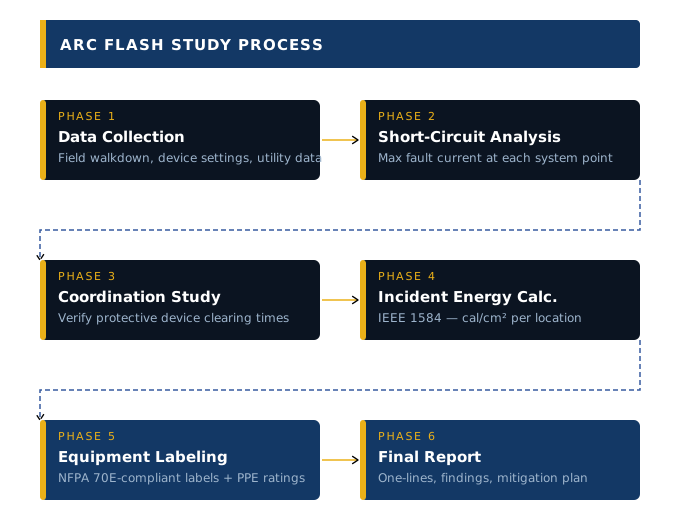
In practice, it takes engineers through a series of steps. First, everything related to electrical systems in the facility, including equipment and protective devices, needs to be thoroughly inspected and measured. Afterwards, engineers run a short-circuit study to establish the highest possible value of fault currents at every location in the electrical system.
They then perform a protective device coordination study to determine if your system will clear a fault quickly enough. Using the IEEE 1584 approach to incident energy calculation, the amount of incident energy is estimated at every location in your electrical distribution system where people perform energized work.
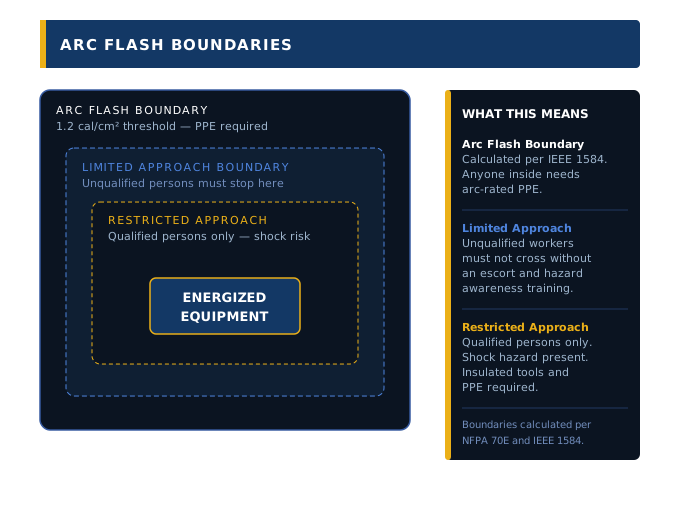
Based on these values, an arc flash boundary for every location in your facility is determined, and then NFPA 70E-compliant warning labels are created, while PPE recommendations are issued.
The end product of this engineering analysis is a report with a complete overview of your facility’s electrical systems, along with equipment labels, PPE requirements, and the prioritized list of changes that could reduce arc flash hazards.
What Causes an Arc Flash?
An arc flash is an uncontrolled release of electrical energy caused by current arcing from one conductor to another, or from a conductor to a ground surface. The temperatures created by this phenomenon can be up to 35,000° Fahrenheit, or four times hotter than the surface temperature of the sun. At the same time, an intense pressure wave, blinding light, and molten metal shrapnel is generated.
While such incidents might seem like a result of some rare occurrence, the vast majority of causes are fairly routine. Human error is the most common factor involved in an arc flash incident. Mistakes in performing energized work lead to over half of all arc flash-related injuries, especially in construction or maintenance tasks.
Some of these errors include dropping tools onto conductive surfaces, accidentally probing the wrong terminal, or simply making a mistake in identification of a circuit breaker being operated. Electrical equipment failures, contamination of equipment, and operating faulty or broken equipment, including opening a circuit breaker, are other frequent factors leading to arc flash incidents.
When Is an Arc Flash Study Required?
There are currently four sources of standards and regulations requiring arc flash studies in various industries.
NFPA 70E
The Standard for Electrical Safety in the Workplace requires facilities to perform an arc flash risk assessment before any work involving energized electrical equipment is conducted. The assessment itself has to contain information about the arc flash boundary, incident energy at a particular location, and the necessary PPE required for the job.
NFPA 70E standards require such studies to be performed at least once every five years, or in case there is a modification of your electrical systems that could impact arc flash risk.

OSHA 29 CFR 1910.333
This standard states that employers are required to assess electrical hazards before allowing workers to perform energized work. During an OSHA audit, your facility will be checked against NFPA 70E standards, effectively making an arc flash study mandatory.
IEEE 1584
IEEE 1584 provides engineering standards for the performance of the incident energy calculation itself, which is essential for determining the degree of risk your facility’s electrical system presents. In accordance with these standards, arc flash hazard analysis has to cover three-phase electrical systems operating at voltages ranging from 208V to 15kV.
NEC 110.16
This code specifies requirements regarding arc flash labels on equipment in your electrical systems that operate above 1,000 amperes. An arc flash study allows facilities to create and maintain accurate and up-to-date equipment labels, instead of relying on generic values.
To cut to the chase: if your facility is operating any electrical equipment where workers perform energized work, you need to conduct arc flash studies.
What Has Changed: Recent Regulatory Updates
There have been three major regulatory changes that make compliance with arc flash studies even more difficult than it already was in 2021.
NFPA 70B Became a Mandatory Standard in 2023
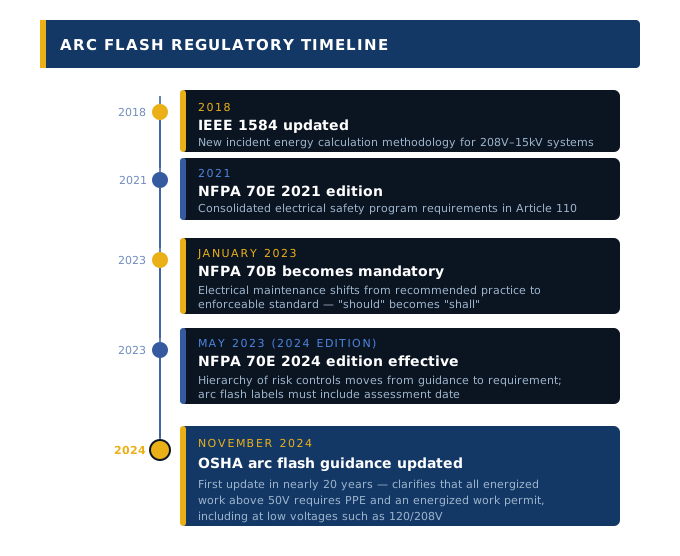
Until 2023, NFPA 70B was a recommended practice for maintaining electrical equipment. However, the 2023 edition classified it as a standard, changing all “should” statements to “shall”. This makes NFPA 70B applicable to OSHA requirements and makes it possible to cite companies for violations.
The link between NFPA 70B and the arc flash studies is important to mention. Arc flash study calculates incident energy taking into account how fast your protective devices will clear the fault. This calculation assumes your breakers and fuses are well-maintained and operate according to their specifications. If your breaker, that should be cleared in 0.06 seconds, has not been tested and maintained for some reason and now clears fault in 0.5 seconds, actual incident energy will be several times higher than incident energy indicated on your panel’s label. The requirement of Electrical Maintenance Program included in NFPA 70B’s mandatory requirements is what bridges the gap. Without this requirement, your arc flash study may contain correct data, but data irrelevant to the actual state of your equipment.
This requirement is relevant not only for industrial facilities. If maintenance worker resets a tripped breaker in your commercial space, he or she performs energized work. Without regular maintenance and an arc flash study performed by a competent person, there is no label that could tell this worker about the actual level of hazard and PPE to use. NFPA 70B, NFPA 70E, and OSHA require it.
NFPA 70E 2024 Tightened Requirements for Documenting Risk Assessment
The 2024 edition of NFPA 70E that became effective in May 2023 made new requirements regarding how the arc flash risk assessment is documented. The main change is related to the hierarchy of risk controls, that was stated in the informational section before, but now is a requirement. Now every risk assessment must state the reasons why other methods, such as de-energization and engineering controls, cannot be used before stating PPE as the control method. An arc flash risk assessment that immediately recommends to wear Category 2 PPE is non-compliant now.
In addition to the changes made to the hierarchy of risk controls, the 2024 edition made stricter requirements for labeling. The label should now indicate the date of the arc flash risk assessment, so that the qualified worker could determine whether the label contains information corresponding to the actual state of the electrical system before performing the energized work. Equipment labeling should be reviewed and, if necessary, updated every time the electrical system is changed.
OSHA’s First Arc Flash PPE Guidance in Nearly 20 Years (November 2024)
On November 25, 2024, OSHA issued an updated version of arc flash PPE guidance for the first time in almost two decades. Although this guidance does not create additional legal obligations, it makes OSHA’s requirements explicit and shows inspectors how to verify compliance. It is worth reading.
OSHA updated its guidance in order to clarify two myths that were found to be the leading causes of arc flash injuries and fatalities. The first one was the assumption that the work is de-energized when it has not been formally locked out and tagged out. In its guidance, OSHA clarifies that de-energization of the circuit does not necessarily provide electrically safe working condition and that the process of de-energization is energized work itself requiring PPE. The second myth is the belief that low voltage systems, specifically 120/208V and 277V circuits that are present in virtually every commercial building, do not produce arc flash capable of melting metals and burning clothes. According to OSHA’s guidance, low voltage systems can generate arc flash incidents with molten metal and cause fatal injuries.
The practical meaning for the facility manager is simple. Any worker who opens an energized panel, resets a breaker, reads a meter or replaces a fuse in any system above 50 volts performs energized work according to OSHA’s requirements. The requirement to have current arc flash study, up-to-date equipment labels and appropriate PPE is valid for the energized work regardless of how ordinary it seems.
Therefore, taken together, these three regulatory updates make compliance exposure of facilities without a current arc flash study broader and more concrete. OSHA can refer to both the mandatory NFPA 70B standard and NFPA 70E while evaluating the electrical safety program of a company. Absence of current arc flash study, lack of maintenance records and labels is an independently citable condition.
The Five-Year Rule and Exceptions
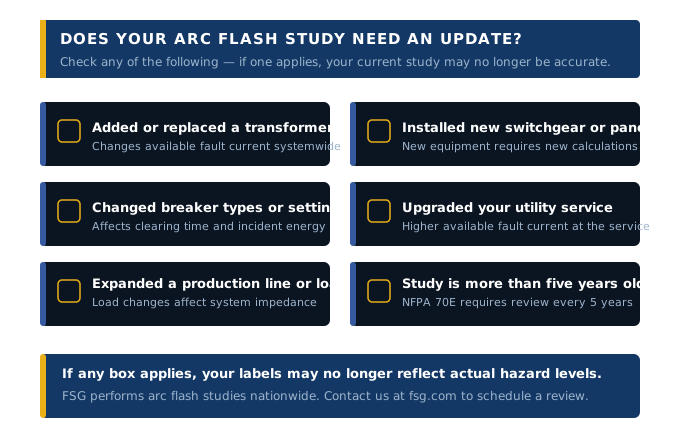
NFPA 70E’s requirement of a five-year interval between studies is a lower bound. However, it is important to keep in mind that if your electrical system sees the addition of new transformers or switchgear, installation of new electrical equipment or expansion of production capacity, replacement of existing transformers, switchgear, or breaker settings, an upgrade of electrical service, or changes to electrical equipment load, then your arc flash study will become obsolete, rendering all the warning labels in your facility irrelevant to current conditions.
A worker in a 12 cal/cm² suit working with electrical equipment that has 40 cal/cm² incident energy will simply have a false sense of security due to their reliance on incorrect equipment labels.
What It Means to Not Have an Arc Flash Study
Deferring or omitting an arc flash study can lead to severe consequences.
Worker injuries: The lack of incident energy calculations will leave your team unable to choose appropriate PPE and avoid burns. For example, think about an employee (maintenance or other) going to reset a circuit breaker after it has tripped out in the backroom. The employee is working on an energized system, and he is performing energized electrical work as per NFPA 70E and OSHA standards for the year 2024, where there is no label to refer to, nor any PPE requirement guidance. The difference between the proper equipment and the incorrect PPE is often the difference between a worker being injured and potentially losing a limb or even their life if an energy release were to occur.
OSHA penalties: Failure to perform an electrical hazard assessment and provide compliant equipment labels will lead to citation under OSHA standards, where fines can range into tens of thousands of dollars.
Legal liabilities: The presence of an OSHA citation alone, especially in case of negligence, is usually enough for plaintiffs’ attorneys to pursue compensation claims in court. Failing to have a current arc flash study in place is often used as evidence.
Inaccurate warning labels: While the existence of any labels on your equipment is better than none, generic labels or labels based on previous studies that do not reflect your current system conditions may actually be more harmful than nothing.
How Arc Flash Studies Are Done
An arc flash study will generally take your facility through three phases.
Phase 1: Data collection via site walkdown (one to three weeks)
Everything related to electrical systems in the facility, including equipment and protective devices, is thoroughly inspected and documented. Utility short-circuit data is also obtained during this phase.
Phase 2: Engineering analysis (two to four weeks)
Your electrical systems are modeled and incident energy levels are calculated at every location where energized work may occur, using IEEE 1584 methodology.
Phase 3: Deliverables (one to two weeks)
The final package includes a detailed engineering report, NFPA 70E-compliant equipment labels, PPE recommendations by location, and a prioritized mitigation plan.
Overall, it can take four to eight weeks to conduct an arc flash study, depending on the size and complexity of your facility.
Who Needs Arc Flash Studies?
Any facility where workers perform energized work at electrical equipment that operates above 50 volts needs to conduct arc flash studies. Manufacturing plants, offices, distribution centers, healthcare centers, and data centers with electrical equipment need to ensure the safety of their employees by conducting a study.
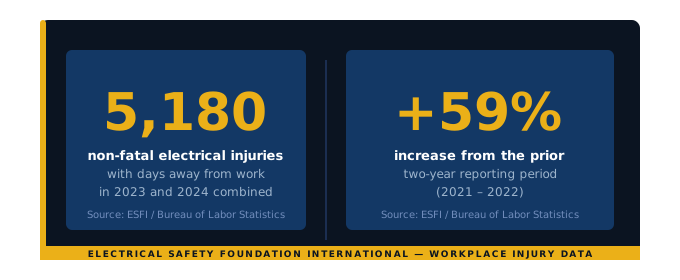
Even relatively small facilities can possess high arc flash risks. According to the latest Electrical Safety Foundation International data, non-fatal electrical workplace injuries requiring workers to spend several days away from work increased by 59% in 2023 and 2024 compared to the prior two-year period, totaling more than 5,000 incidents.
While arc flash injuries are concentrated in manufacturing, they occur across almost every sector utilizing electrical equipment.
How FSG Provides Arc Flash Studies
Since 1982, FSG has been providing electrical services to commercial and industrial clients and has over 25 years of arc flash experience. We offer integrated arc flash studies with our electrical inspection services. From infrared thermography to switchgear inspections and protective device testing, we can provide both a snapshot and the current state of your electrical systems in terms of arc flash risks and hazards.
Performing an arc flash study, our company conducts a site walkdown, collects data from your electrical systems, performs incident energy calculations using IEEE 1584 standards, creates equipment labels, and issues PPE guidelines based on the collected data. All this work is performed in-house without delegating technical duties to a third party.
This allows us to offer recommendations to minimize arc flash hazards at your facility based on our findings, along with performing these engineering tasks within a reasonable timeframe, and incorporating mitigation into existing electrical maintenance programs.

At the conclusion of this process, FSG provides accurate equipment labels reflecting current conditions of your electrical systems, appropriate PPE recommendations, documented OSHA compliance, and a prioritized list of recommended improvements to mitigate arc flash risks.
If you’ve missed the five-year deadline or undergone significant changes to your electrical system, consider scheduling an arc flash study to make sure your equipment labels reflect current risks.