If you operate a parking garage, one of the most crucial decisions you’ll make is lighting.
Proper parking garage lighting is important. It affects safety and liability risks, energy costs, and how your tenants and guests feel when they are walking to their cars at night.
Your facility should be in compliance with Illuminating Engineering Society (IES) parking lighting standards to ensure the best results for your parking garage.
This guide covers standards in detail and shows what you need to consider when it comes to upgrading your lighting system in your parking garage.
Why Parking Garages Require Specific Lighting Approaches
When it comes to lighting of parking garages, there are several features that make it a unique and challenging task in comparison with other commercial spaces.
Mixed illumination: The area near entrances and open decks receives daylight; interiors are completely closed.
Low ceiling: There is a relatively low ceiling in comparison with the area the lights illuminate.
Moving vehicles: Pedestrians walk between narrow spaces. There are stairwells, ramps, and transitional areas with eye adjustment challenges.
Different types of occupancy: A corporate parking garage is busy in the morning but empty in the evening. A hospital garage has maximum occupancy 24/7. The lighting system has to work reliably in any conditions.
Research shows that illumination is the single most significant factor in users’ perception of safety in parking garages and plays a huge role from the standpoints of safety, user satisfaction, and liability management.

IES Standards for Lighting of Parking Garages
There is a standard for the lighting of parking garages in the US from the IES. It is the standard engineers, lighting contractors, and code officials refer to while evaluating illumination of a facility. These codes cover all types of parking facility lighting.
This standard provides illuminance levels and the requirement for the average-to-minimum uniformity ratio in different areas. According to the standard, the illuminance has to be measured in foot-candles (fc) and the ratio of average to minimum illuminance has to be no higher than 10:1, according to The Lighting Design Lab. The uniformity of the lighting is a key factor of safety in addition to illuminance.
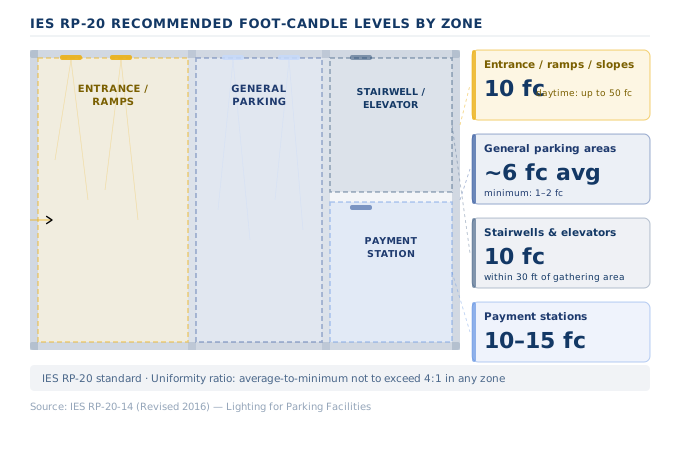
There is a summary of IES foot-candle recommendations for different parts of the garage:
General Parking Areas and Driveways
Illumination of general parking areas has to be 6 fc on the pavement on average with 1 to 2 fc as a minimum. Occupancy-based controls allow reducing electricity usage while maintaining high lighting levels in occupied areas reliably.
Entrance and Exit Zones
Illumination of entrances, exits, ramps, and slopes has to be 10 fc. In the daytime period, transitional zones of the entrance area should be illuminated up to 50 fc in order to compensate for the effect of the so-called “black hole” – the phenomenon of losing the ability to see due to bright daylight.
Stairwells and Pedestrian Gathering Areas
Illumination of stairwells, elevator lobbies, and pedestrian gathering areas should be 10 fc within a radius of 30 feet. These places are risk zones for slip and fall accidents. According to OSHA, 15% of such accidents occur because of poor lighting in stairwells and pedestrian gathering areas.
Payment and Transactional Areas
Payment stations should be illuminated by 10 to 15 fc of light.
Apart from these zone-specific recommendations, the standard provides guidance on correlated color temperature (CCT) and color rendering index (CRI) for parking garages. CRI in parking garages is especially important because security cameras record video that has to be analyzed for identification.
Poor CRI from a fixture can make identification impossible.
Energy Codes and Compliance Beyond IES
While the IES provides illuminance recommendations, there are other standards that facility managers have to be aware of.
The ASHRAE 90.1-2019 standard defines energy efficiency of the lighting systems in parking garages and provides lighting power density (LPD) limits. LPD limits define the maximum energy consumption per square foot. There are also requirements for automatic controls for turning off lights in unoccupied or daylight areas.
The NFPA (National Fire Protection Association) provides recommendations for lighting in emergency situations. According to NFPA, the illumination of the pathway to an emergency exit should be at least 1 fc and have a backup power source in case of a power outage.
It’s also recommended to check local and state codes as they could include stricter requirements regarding energy consumption and light pollution regulations that have an influence on fixture selection and aiming angles.
The Financial Case for Upgrading to LED
If your parking garage still uses metal halide or high-pressure sodium fixtures, the economic arguments for switching to LED are clear.
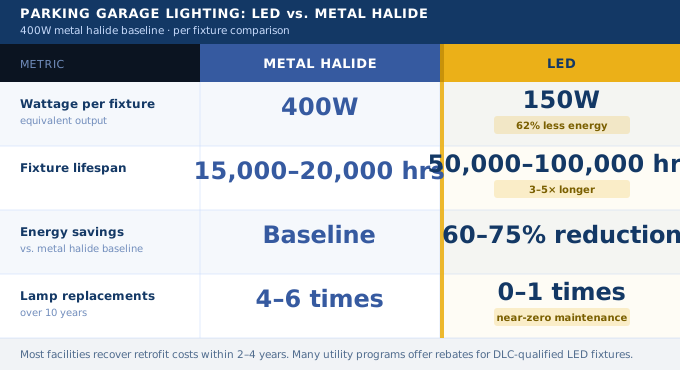
Most parking facilities see a 60 to 75% reduction in energy usage after an LED retrofit. Replacement of a 400-watt metal halide fixture with a 150-watt LED provides a 62% reduction in energy consumption while delivering equivalent or even higher illumination.
The maintenance benefits are equally significant – the 50,000 to 100,000-hour lifespan of LED fixtures compared to 15,000 to 20,000 hours for metal halide means fewer lamp replacements and lower lift rental costs.
In one documented lighting retrofit project, 45-watt LED units replaced high-pressure sodium fixtures, resulting in a 76% reduction in energy consumption and $14,000 per year in savings. The client also received $23,000 in utility rebates for the project.
Significant utility rebates are available for LED lighting upgrade projects. An experienced contractor can help identify those rebates and handle the necessary applications.
Lighting Controls: Where Cost Savings Are Made
A fixture is not the whole story for a parking garage. How the fixture is controlled is a key factor in the energy efficiency of your facility.
Occupancy-based bi-level controls are widely used in parking garages as the most efficient and economical solution. The sensor dims the fixture to a defined minimum level (typically 20 to 30%) in unoccupied areas and returns it to normal illumination within seconds when someone enters the zone. As a result, the facility always has adequate lighting in occupied areas and runs with reduced energy consumption everywhere else.
Daylight harvesting controls add to that. When natural light is present, fixtures near daylight zones reduce to minimum output and step back up when conditions change.
Additional savings were identified in a retrofit with 200 fixtures and bi-level occupancy controls installed – an extra $20,000 per year in savings compared to the LED upgrade alone.
A networked lighting control system allows you to monitor light levels in each zone from a single dashboard and receive alerts about problems. Energy consumption data collection is also possible for sustainability reporting.
What to Look for in a Parking Garage Lighting Contractor
While standards and specifications play a key role, the right contractor is also essential to a successful project. Here are the factors to consider when choosing a contractor for your parking garage.
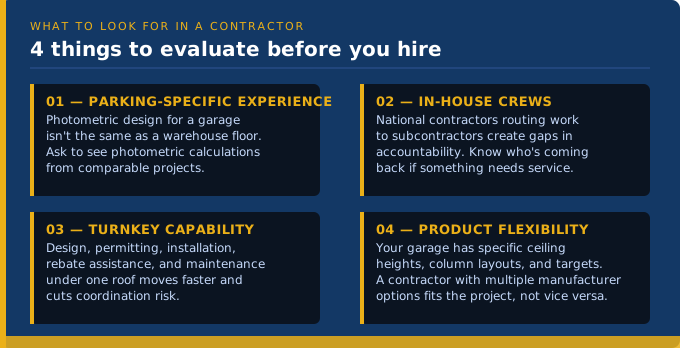
Experience in parking garages: Photometric design for a garage is not the same as for a warehouse or retail floor. There are different ceiling heights, column spacing, and reflectance values between painted and exposed concrete, along with zone-specific lighting requirements that influence the design. Ask potential contractors to provide examples of similar projects and their photometric calculations.
Contractor’s crew or subcontractors: National companies that rely on local subcontractors can have accountability gaps. You need to know who to contact when problems arise.
Turnkey capability: A contractor who can handle design, permitting, procurement, installation, and ongoing maintenance is the best choice. That single point of accountability makes for a more efficient project than coordinating across multiple vendors.
Fixture flexibility: There are several types of LED fixtures suited to different ceiling heights, column layouts, mounting angles, and lighting requirements. Ask whether the contractor works across multiple manufacturers to find the best solution for your specific facility.
FSG provides parking lot lighting services for all types of parking facilities, including parking garages. With offices in 30+ markets and local crews that install the system and support it long-term.
Our teams will conduct an assessment of your facility, prepare photometric design according to IES standards, and build a project scope that accounts for available utility rebates and your budget. Contact us to get started.

Is a Full Retrofit of the Lighting System Always Required?
Sometimes it is not. If your fixtures are in good condition and still provide proper lighting, a retrofit kit can be a less expensive and faster solution than complete fixture replacement. It is a case-by-case decision based on the age, mounting type, and condition of the existing fixtures.
If the fixtures are outdated or failing, complete replacement is the better path because it resets the maintenance cycle and provides a longer service life for the new system.
In either case, the first step is a lighting audit, a systematic analysis of all fixtures that determines their current and expected output and identifies gaps relative to IES recommendations. That data drives a project tailored to the actual needs of your facility. FSG’s lighting experts can conduct that audit and provide both retrofit kits and complete fixture replacement for your parking garage.
If your current lighting system fails to provide sufficient illumination and energy efficiency, the economics of upgrading are straightforward.
Project Profile
Many parking garages across the U.S. have been upgraded to LED, but many more still need to make the upgrade. Here is a project profile of a parking garage lighting upgrade completed by FSG.
The AT&T Performing Arts Center in Dallas worked with FSG to retrofit their parking garage lighting. The facility is benefiting from a large reduction in its energy bill, brand new lighting making the garage brighter and safer, and reduced maintenance demands.
Watch the video below to learn more about this project.
The Safety Arguments Are Valid
Arguments in favor of parking garage lighting for safety reasons do not stop at fall prevention. Parking structures have been repeatedly found to be among the most frequent places for violent and property crimes in the US. As stated in a research brief from the National Institute of Justice, the most significant Crime Prevention Through Environmental Design (CPTED) security measure in any parking garage is lighting. More important even than cameras, signs, or staffing.
Additionally, the research brief suggests that CPTED measures, including adequate lighting, should be built into a facility from the beginning of its design and construction process as making such additions retroactively is hard and costly.
This way, facility managers of an existing structure should consider their lighting condition as one of the elements of crime exposure risk assessment. When lighting enhancements become part of a comprehensive safety approach, the resulting deterrence effect is proven and quantifiable.
Moreover, there is a liability aspect involved. Inadequate lighting leading to an incident in your facility has become a recognized exposure. On the other hand, properly functioning lighting meeting IES RP-20 requirements would be a solid ground for your facility safety.
How to Get Started
Whether it is a corporate campus garage, a hospital structure, a municipal facility, or a retail parking deck, the principles of proper lighting are the same. Meet IES illuminance recommendations by zone, achieve uniform light distribution, deploy energy-efficient LED technology with smart controls, and maintain the system. FSG also offers parking lot lighting services for open surface lots.
If your parking garage has an aging lighting system that fails to meet IES standards, our team will help you choose the right solution, whether that is a retrofit kit or full fixture replacement. Contact us to start your project.